

TL;DR — The Seven Variables Behind Every Windrow Cover Quote
- Base cloth denier (300D vs 600D) is the single largest per-square-metre driver. The 600D version uses roughly 1.7× more poly oxford yarn per square metre than the 300D version.
- Fabric weight (370 vs 500 g/m²) follows the base-cloth density and is the second-largest driver. Both are published on the datasheet; both move with raw-yarn pricing.
- Width matters most at the extremes: above 2 m triggers custom-tooling tiers; below 1.5 m adds per-roll waste. The 1.5–2.0 m band is where our line is most cost-effective.
- Surface treatment (single-side vs double-side ePTFE lamination) adds a single-digit to low-double-digit percentage, not a doubling. Most windrow covers ship single-side.
- MOQ matters more than buyers expect. Below 1,000 m² the per-square-metre curve is steep; above 5,000 m² it flattens; full-container load is the floor.
- Hidden cost lines (packaging, ocean freight, DDP terms, certification) sit outside the published per-square-metre price and must be added back to land a true delivered cost.
- Customization (edge reinforcement, grommets, printing, custom length) is where RFQs commonly under-budget by a low-double-digit percentage.
Seven Variables That Decide a Windrow Cover Quote
When a windrow compost cover quote lands in a buyer’s inbox, the figure at the bottom looks like a single number. It is not. It is the product of seven independent variables, each of which can move the total by a low-single-digit to low-double-digit percentage of the per-square-metre base. The order in which we walk through them below is the order we walk a buyer through on a video call when we open an RFQ, because the seven variables line up cleanly with the seven questions a procurement engineer has to answer before the factory can return a meaningful number. We have been quoting both published grades — CY-003 and CY-004 — on this exact seven-variable template since 2022, and the buyers who skip straight to “send me a price” end up coming back two weeks later with revisions we could have caught on day one.
The seven variables are: (1) base cloth denier, (2) fabric weight, (3) width and length, (4) surface treatment, (5) order quantity, (6) customization details, and (7) hidden cost lines. Variables 1 through 5 are quoted on the per-square-metre price; variables 6 and 7 are quoted as separate line items. A buyer who only sees the per-square-metre number is missing roughly 30% of the landed cost on a typical order, and almost all of the surprise in any windrow cover RFQ we see comes from variables 6 and 7, not from the base cloth.
The two questions our sales engineers ask first on every windrow cover RFQ: how many square metres in the first order, and what is the destination port. Everything else falls out of those two answers plus the four material-spec questions that follow them.
For the published product line that anchors this discussion, our ePTFE window cover products range covers both grades referenced in this article; the specific 300D/370 g/m² grade is the ePTFE composting cover product page, and the 600D/500 g/m² grade is the agricultural-waste version on the same product family. For buyers who want to skip the worksheet and go straight to a request, the request a bulk quotation channel is the fastest route; we typically return a quote within one business day on standard specs and within three business days on custom specs.
Base Cloth Denier: Why 300D and 600D Sit in Different Price Tiers
Denier is the linear mass of a single filament of yarn, expressed in grams per 9,000 metres of filament. A 300D yarn weighs 300 grams per 9,000 metres; a 600D yarn weighs 600 grams per 9,000 metres, so it is exactly twice the linear mass. In a poly oxford weave, doubling the denier does not double the fabric’s mass per square metre — because the weave density (threads per cm) also stays roughly constant — but it does substantially increase the fabric’s tensile strength, abrasion resistance, and tear strength. Those improvements justify a price step from one tier to the next. We explain this on every RFQ call because most procurement engineers coming from a non-woven background do not have the denier intuition that a textile buyer would, and the per-square-metre delta between the two grades reads as arbitrary without it.
The reason 300D and 600D sit in different price tiers on every quote we produce is that the 600D yarn uses roughly twice as much poly oxford feedstock per linear metre of fabric. At a given fabric weight, the higher-denier grade shifts the cost ratio from yarn to membrane and finish; at the published Chaoyue’s CY-003 (600D, 500 g/m²) versus CY-004 (300D, 370 g/m²) comparison, the price gap reflects the yarn feedstock delta plus the lamination-area delta that comes with the higher fabric weight. We share the relative tier only; the absolute gap moves with raw-yarn pricing, which is itself a function of the upstream poly oxford market.
For buyers comparing our 300D and 600D windrow covers, the practical decision tree is turning frequency and UV exposure. A static or rarely-turned pile on a sheltered site accepts the 300D grade without complaint; a high-frequency turning site (weekly or more often) or a fully exposed outdoor pile benefits from the 600D grade’s higher tear strength, which translates directly into longer service life. We walk through this trade with every buyer who is on the fence between the two grades, and in most cases the answer is the same: the heavier grade pays for itself in service life on a turning site, but not on a static site.
Fabric Weight: How 370 g/m² and 500 g/m² Maps to Per-Square-Metre Cost
Fabric weight in g/m² is the single most legible number on a windrow cover datasheet. It is the mass of one square metre of the finished fabric, and it captures the combined contribution of yarn density, weave density, and any coatings or laminations applied to the surface. Our two published windrow cover grades sit at 370 g/m² (CY-004) and 500 g/m² (CY-003); the 35% weight delta is the difference between a lighter single-side and a heavier double-side laminated cover, and it shows up in the per-square-metre price tier accordingly. We have watched buyers fixate on fabric weight to the exclusion of the underlying base-cloth density, which is why we walk them through the table below on every RFQ rather than just quoting the g/m² number in isolation.
| Specification | CY-004 (300D grade) | CY-003 (600D grade) |
|---|---|---|
| Composition | 300D 100% poly oxford | 600D 100% poly oxford |
| Construction | poly oxford + PTFE + poly oxford | poly oxford + PTFE + poly oxford |
| Fabric weight | 370 g/m² | 500 g/m² |
| W.P.R (water pressure resistance) | > 20,000 mm | > 20,000 mm |
| W.V.P (water vapor permeability) | 5,000 g/m²·24h | 5,000 g/m²·24h |
| Size | customized | customized |
What the table does not show is that the W.P.R and W.V.P figures are functionally identical between the two grades because the membrane layer is the same on both. The membrane is what blocks liquid water and breathes water vapor; the base cloth is what carries the mechanical load. So a buyer who is choosing between the two grades on W.P.R alone will see no difference; a buyer who is choosing between the two on tear strength, abrasion resistance, or expected service life on a turning site will see a substantial difference in favour of the 500 g/m² grade.
The fabric weight also maps to shipping cost in ways that are not obvious at first glance. A 500 g/m² grade rolls into a smaller linear-metre payload per container than a 370 g/m² grade for the same square-metre order, because each roll carries more mass. For buyers buying on a per-roll basis, this is a shipping penalty; for buyers buying on a per-square-metre basis at FOB or EXW terms, the ocean freight cost is independent of the fabric weight, so the per-square-metre quote comparison is clean.
Width and Length Customization: The Width-Pricing Curve Nobody Publishes
Width is the third largest driver, and it is the one most buyers do not realise is variable until they see the quote. Our lamination line runs most cost-effectively in the 1.5 m to 2.0 m width band; above 2 m we enter custom-tooling territory, and below 1.5 m we hit per-roll waste surcharges because the trim cuts consume a higher percentage of the input roll. The published “customized” size note on both CY-003 and CY-004 covers this honestly — the cover can be made to any width the buyer specifies, but the price moves with the width. We have revised probably one in five RFQs we receive in 2024 to a width in the 1.5–2.0 m band, and the buyers have ended up with a lower per-square-metre price without changing their pile dimensions.
The width-pricing curve is roughly piecewise linear. In the 1.5–2.0 m band, the per-square-metre price sits at the published tier. In the 2.0–2.5 m band, the per-square-metre price steps up because of the wider lamination head required; in the 2.5–3.0 m band it steps up again. Below 1.5 m, the per-square-metre price also rises, but for a different reason: the trim waste as a percentage of the input roll goes up, and that waste cost is amortised across a smaller output roll. The most cost-effective width is 1.8 m on our line, and we steer most RFQs into the 1.5–2.0 m window when the pile dimensions allow.
Length is a simpler story. Custom length is essentially free up to the practical roll diameter limit (typically 0.5 m roll OD for our line, which corresponds to roughly 100–150 linear metres at 1.8 m width); beyond the practical roll diameter, we cut to multiple rolls rather than a single jumbo roll, and the per-square-metre price does not change but the buyer takes multiple rolls and the per-roll waste percentage stays the same. Length-driven price surprises are rare; width-driven price surprises are the most common RFQ revision we see.
The single most common RFQ revision we work through with new buyers: the buyer requests a 2.4 m width based on their pile geometry, sees the quote, and we end up at a 1.8 m width with a sewn seam because the pile width is actually 3.4 m and a 1.8 m panel covers it with a single seam at the apex of the windrow. The result is a lower per-square-metre price and a faster lead time, and the seam holds through the same number of turning cycles as the rest of the cover.
Surface Treatment: Single-Side vs Double-Side ePTFE Lamination
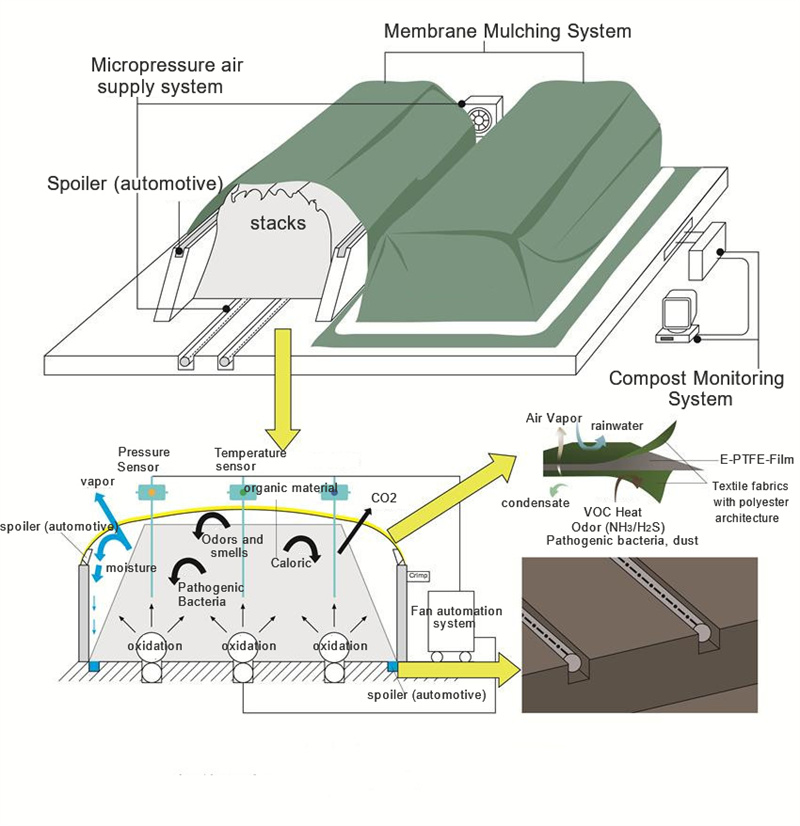
Surface treatment is the easiest of the seven variables to explain and the one most often misconfigured. A windrow compost cover is, mechanically, a sandwich: a base cloth, an ePTFE membrane layer, and a second base cloth (or a single-face finish, depending on configuration). The membrane layer is what does the work — it blocks liquid water, breathes water vapor, contains odors, and reflects heat. The base cloth is what carries the mechanical load and gives the cover its abrasion and tear resistance.
Single-side lamination is the default for windrow covers, and it is the configuration in which the membrane sits between the two base cloths (sandwich construction, as published on both CY-003 and CY-004). The cover is symmetric in performance: both faces look and behave the same from the outside, and both faces are equally protected from contamination. Double-side lamination, in our product context, refers to applying the membrane on both faces of a single base cloth — a configuration that is occasionally requested for covers that will be exposed to liquid on both faces (for example, a windrow that gets rained on from above and sweats condensate from below). It is not the same as a thicker membrane layer, and the cost adder is a single-pass lamination step, not a doubling of the membrane thickness.
For most windrow composting sites — outdoor piles in temperate climates, static piles in covered bays, and aerated static piles in purpose-built facilities — single-side lamination is sufficient. Double-side lamination is reserved for unusual service environments: piles that get flipped and rolled, covers that are deployed fabric-side-up against wet ground, or sites where the cover is reused across many piles and is regularly hosed down. We default to single-side on every RFQ unless the buyer explicitly calls out the use case for double-side, and that single-side default is what produces the published per-square-metre tier.
For buyers who want to verify the lamination configuration before placing the order, the certificate that ships with every Chaoyue windrow cover includes a column that lists the construction (poly oxford + PTFE + poly oxford for both grades), the W.P.R, the W.V.P, the fabric weight, and the lot-traceable membrane batch number. A buyer who needs a different construction can specify it on the RFQ; we return a separate quote with the alternative construction priced accordingly.
Order Quantity: The MOQ Curve and How It Flattens at Container Load
Order quantity is the fifth driver and the one with the largest impact on landed cost per square metre. Our published MOQ is one roll (typically 50–100 linear metres depending on width) for standard specifications, and 500 m² minimum for custom specifications. Below 500 m², we accept orders but the per-square-metre price includes a setup surcharge; below 1,000 m², the per-square-metre curve is steep because setup and waste recovery dominate; at 5,000 m² the curve flattens noticeably; at full-container load (≈ 30,000 m² depending on width and roll diameter) the per-square-metre price is at its floor.
| Order quantity (m²) | Per-square-metre price band (relative, lowest tier = 1.0) | Setup surcharge | Typical lead time |
|---|---|---|---|
| < 500 (custom) | Order accepted; quote includes setup surcharge | Yes | 15–20 business days |
| 500 – 1,000 | 1.5 – 2.0× entry tier | Reduced | 15–20 business days |
| 1,000 – 5,000 | 1.2 – 1.4× entry tier | Amortised | 20–25 business days |
| 5,000 – 30,000 | 1.0 – 1.1× entry tier | Fully amortised | 25–30 business days |
| ≥ 30,000 (container load) | 1.0× entry tier (floor) | None | 30–35 business days |
The reason the curve flattens at 5,000 m² is that the lamination line is set up once per order, and the setup time is the same whether the order is 500 m² or 5,000 m². The setup cost amortises across the larger order, and waste recovery (the trim from each input roll that does not make it into a finished roll) also amortises. By 30,000 m², the line is running long enough that the setup and waste are negligible per square metre, and the per-square-metre price is at the floor that the raw-material and lamination cost structure will support.
For buyers considering a smaller initial order, the practical advice we give is to consolidate orders with neighboring composting sites, or to order the larger quantity and warehouse the surplus for the second site. A buyer who orders 500 m² today and 500 m² six months from now pays the setup surcharge twice; a buyer who orders 1,000 m² in a single order pays the setup surcharge once. The consolidation logic is the single largest cost lever a small-site buyer has, and it is the reason we ask about neighbouring sites on every video call.
Hidden Cost Lines: Packaging, Ocean Freight, DDP Terms, and Warranty
Hidden cost lines are the seventh variable, and they are the variable that catches the most new buyers off guard. The published per-square-metre price excludes packaging, freight, destination import duties, and any in-country certification fees; these are quoted as separate line items on every RFQ. A buyer who lands on the published price and forgets to add the line items typically underestimates landed cost by a low-double-digit percentage, which is exactly the kind of surprise that derails a procurement plan.
- Packaging. Woven bag + pallet (fumigation-free for EU/US/AU buyers) or carton, at the buyer’s choice. Per-roll packaging cost is a low-single-digit USD figure that adds up across a large order but is a rounding error per square metre.
- Ocean freight. Quoted separately at FOB Ningbo or EXW Ningbo; can be rolled into a DDP quote on request. Per-container ocean freight has been volatile post-2020; we share the current freight assumption in the quote and refresh it at booking confirmation.
- Destination import duties. Vary by destination HS code and country of origin. We list the HS code on the commercial invoice and let the buyer’s broker handle duty assessment.
- Certification fees. In-country certification (US composting council seal, EU EN 13432 compostability, etc.) is the buyer’s responsibility; we provide the test reports and material safety data to support the buyer’s submission, but the certification fee is on the buyer side.
- Warranty. 12 months from bill of lading date for material defects under our published terms. Warranty is included in the published price; it is not a separate line item, but it is a hidden value the buyer should not forget to use.
The single most common landed-cost under-estimate we see: a buyer plans on the published per-square-metre price plus ocean freight, and forgets to budget for destination import duties and the in-country certification fee. On a 5,000 m² order, those two omissions alone can swing the landed cost by a low-double-digit percentage, which is enough to break a grant-funded project budget that was set without the line items.
For the standards that govern the membrane layer in both windrow cover grades, the ASTM D6400 compostable plastics standard mirror on iTeh and the EN 13432 compostability standard mirror on iTeh are the two references a buyer is most likely to be asked for in a tender. The membrane layer itself is not a compostable plastic in the strict ASTM D6400 sense (PTFE is not biodegradable in industrial composting timescales), so we are careful in our documentation not to describe the membrane as compostable; the cover as a whole is an industrial textile, not a compostable plastic, and buyers who need an EN 13432 certification are looking for a different product category. For the broader regulatory context, the EPA composting overview and the ISO 17088 compostable plastics standard mirror on iTeh cover the framing for what a compostable plastic is and is not, and our certification page lists which standards our windrow cover grades are tested against.
Frequently Asked Questions
What is the cheapest ePTFE windrow compost cover you can supply?
The lowest-cost standard grade is our CY-004 at 300D / 370 g/m², single-side lamination, standard width up to 2 m, MOQ 1 roll. For buyers willing to accept that combination of specifications, the quote sits at the entry tier of our published ladder. Lighter construction is not something we offer below 300D because the windrow environment punishes thin base cloth faster than the price saving can recover.
How much does doubling the fabric weight (370 → 500 g/m²) change the price?
The 600D / 500 g/m² CY-003 grade sits in a higher price tier than the 300D / 370 g/m² CY-004 grade, with the gap driven by the additional base-cloth mass and the extra ePTFE laminate area, not by a change in lamination process. We share the relative tier rather than a percentage figure because raw-material pricing moves monthly.
Is a custom width more expensive than a standard width?
Yes. Widths above 2 m typically fall into a custom-tooling tier because they require a wider lamination line; widths below 1.5 m reduce yield per roll and add a per-roll waste surcharge. The most cost-effective width on our line is the 1.5–2.0 m band, and we steer most RFQs into that window when the buyer’s pile geometry allows.
Does a double-side ePTFE lamination double the price?
No. Double-side lamination adds a second pass through the lamination line, not a second membrane thickness. The cost adder is a single-digit to low-double-digit percentage of the base quote, depending on width and total square metres ordered. We default to single-side lamination unless the buyer explicitly calls out a use case where both faces will be exposed to moisture or contamination.
What is the MOQ and how does it move the price?
Our published MOQ is 1 roll (typically 50–100 linear metres depending on width) for standard specifications, and 500 m² minimum for custom specifications. The price-per-square-metre curve flattens noticeably at 5,000 m² and again at full-container load (≈ 30,000 m² depending on width and roll diameter); below 1,000 m², the curve is steep because setup and waste recovery dominate.
What is not included in the per-square-metre price?
The published price excludes packaging (woven bag + pallet or carton, by buyer choice), ocean freight or air freight (Incoterms typically EXW Ningbo or FOB Ningbo), destination import duties, and any in-country certification fees. Warranty is included for 12 months from bill of lading date for material defects under our published terms.
Can you share an all-in delivered price to my country?
All-in delivered (DDP or DAP) pricing requires a quantity, an Incoterm, and a destination port or postal code. We quote that on request through our contact channel; the variables are too site-specific to publish a generic DDP figure here.
Does a thicker cover last longer and therefore reduce lifecycle cost?
Generally yes for harsh outdoor windrow sites, but not always. A 500 g/m² cover survives more turning cycles than a 370 g/m² cover, but on a sheltered static pile the lighter cover can deliver the same service life. We match the grade to the turning-frequency and UV-exposure profile of the site rather than defaulting to the heaviest grade.
About the Author
Written by The Chaoyue Membrane Engineering Team at Ningbo Chaoyue New Material Technology Co., Ltd.
The Chaoyue membrane engineering team is the production and applications group at Ningbo Chaoyue New Material Technology Co., Ltd. (Cixi, Ningbo, Zhejiang). The team runs PTFE filter membrane, PTFE textile membrane, and ePTFE composite-material production across indoor and outdoor fabric, dust-collection, air/liquid filtration, electronic, medical, food and biological-industry applications. The same lamination line that supplies the windrow-compost-cover grades (CY-003 and CY-004) also supplies the company’s protective-vent and air-filter-membrane product families; the team publishes base-cloth density, fabric weight, W.P.R and W.V.P on every datasheet so that a buyer can match grade to windrow environment before requesting a quote.
Contact: www.cy-ptfe.com
Post time: Aug-27-2026